Tweet about this on TwitterPin on PinterestShare on LinkedInShare on Google+Email this to someoneShare on FacebookShare on VkontakteShare on Vkontakte

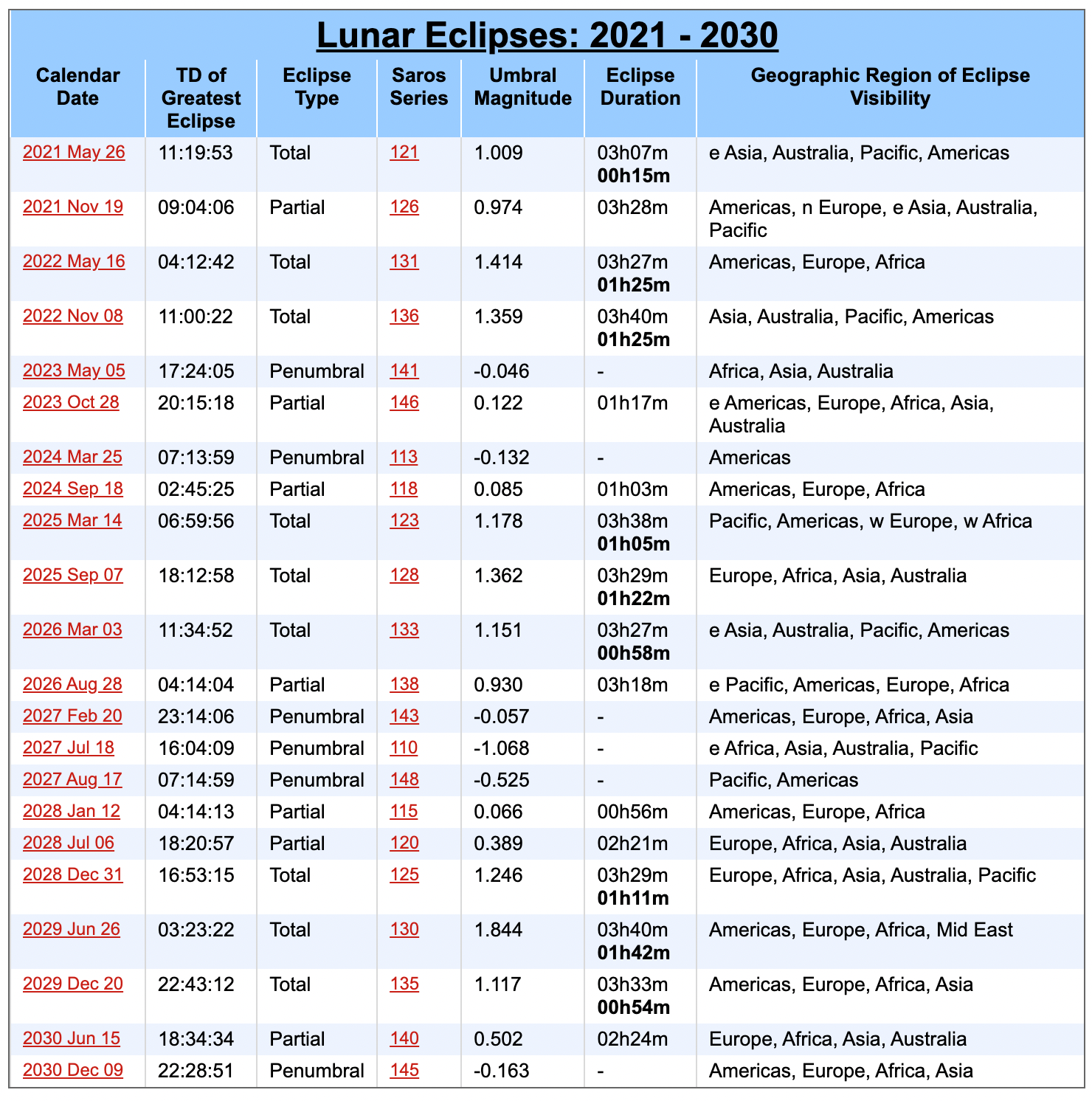
Lunar Eclipses – 2021-2030

Eclipses recur over the Saros cycle, a period of approximately 18 years 11 days.

The saros is a period of exactly 223 synodic months, approximately 6585.3211 days, or 18 years, 10, 11, or 12 days (depending on the number of leap years), and 8 hours, that can be used to predict eclipses of the Sun and Moon.

https://en.wikipedia.org/wiki/Saros_(astronomy)

Tweet about this on TwitterPin on PinterestShare on LinkedInShare on Google+Email this to someoneShare on FacebookShare on VkontakteShare on Vkontakte

Panic at the Library

Though Huntington died in 1927, he intended his collection to live on long after him, but as the librarians discovered, the volumes were literally too full of life. The problem with assembling a massive collection of books is that you necessarily collect the very organisms that feed on books.

Tweet about this on TwitterPin on PinterestShare on LinkedInShare on Google+Email this to someoneShare on FacebookShare on VkontakteShare on Vkontakte

Tsar Bomba – Unclassified Footage

Rosatom has released previously classified footage of the largest bomb to ever be detonated, Tsar Bomba.

With a yield of 50 megatons (50 million tons), equal to around 3,800 Hiroshima bombs, the weapon was set off over Novaya Zemlya on October 30, 1961

https://thebarentsobserver.com/en/security/2020/08/rosatom-releases-previously-classified-documentary-video-50-mt-novaya-zemlya-test

Update: I think they took it down? So, this seems to be a re-upload: https://www.youtube.com/watch?v=XJhZ3i-HXS0

Tip: YouTube’s auto-translated captions do a great job turning it into english.

Tweet about this on TwitterPin on PinterestShare on LinkedInShare on Google+Email this to someoneShare on FacebookShare on VkontakteShare on Vkontakte

The lost art of getting lost

Discovery used to mean going out and coming across stuff – now it seems to mean turning inwards and gazing at screens. We’ve become reliant on machines to help us get around, so much so that it’s changing the way we behave, particularly among younger people who have no experience of a time before GPS.